O'Reilly Training: The Hard Parts of Architecture
Goal
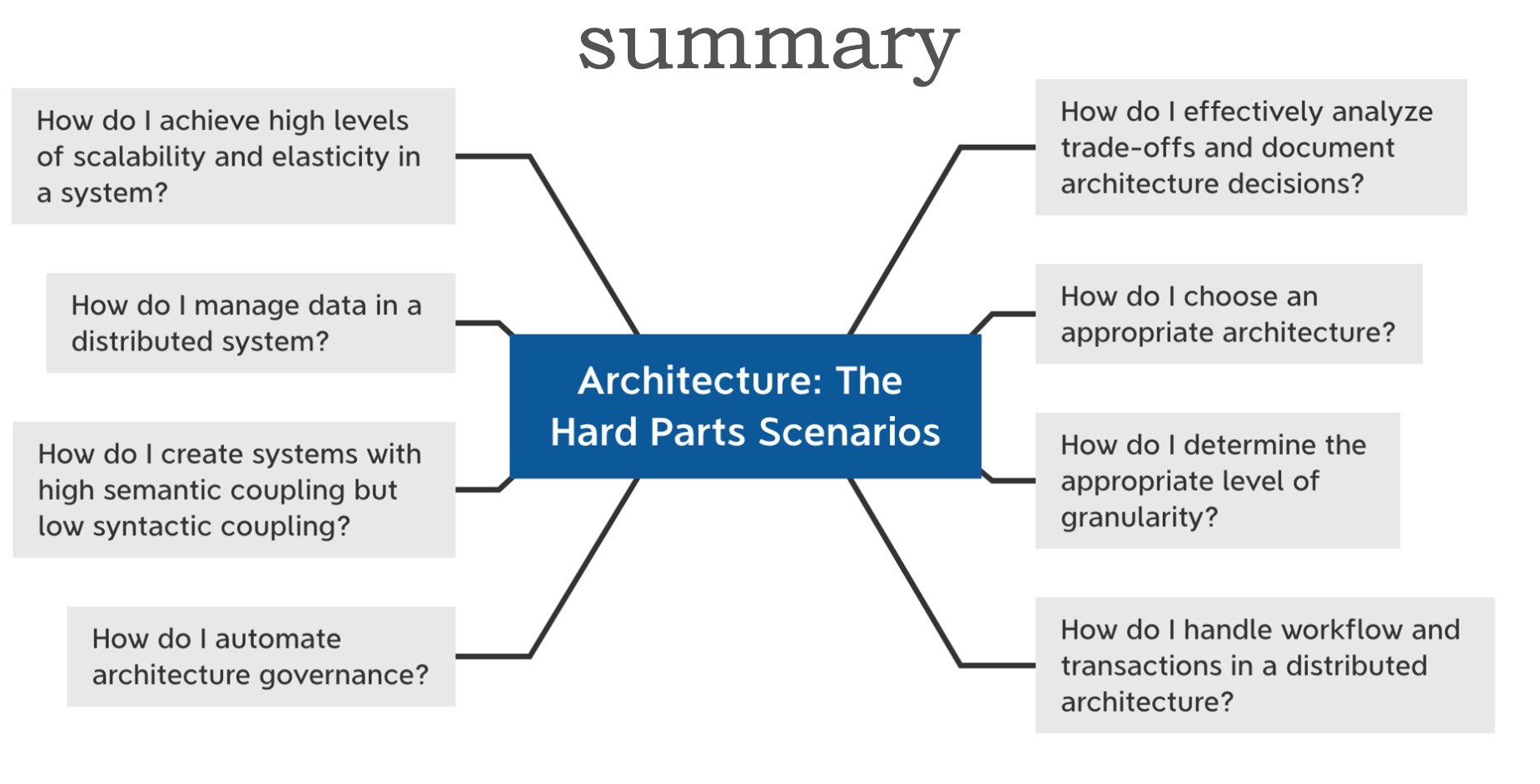
Decisions
- It Depends. Decisions are a trade-off!
- Why > How
- Use Architectural Decision Record (ADR)
- Title
- Status
- Context
- Decision - Justification (Technical and Business)
- Consequences - Trade-offs
- Example:
Title
----
Single consolidated payment service

Context
----
A customer can use any payment type combination (credit card, paypal, store credit, and gift cards) when placing an order.

Payment is required when pacing an order (synchronous activity). The payment logic can be either a single consolidated service or a separately deployed service for each payment type.

Decision
----
We will use a single consolidated payment service for all payment types.

Separating the services would require orchestration, which incurs both network and security latency. A single payment service will be more responsive since it does not require orchestration of each payment, therefore improving customer satisfaction when placing orders.

Consequences
----
The tradeoff of this decision is that maintenance, testing, and deployment will be impacted when changes are made to any of the payment types or another payment type is added. Testing scope is increased, requiring more time for complete testing. Deployment risk is increased as deploying a single service requires deployment of all payment types. Error handling and transactions are maintained in a single consolidated service, improving overall data integrity, data consistency, and performance when errors occur. This also improves overall customer satisfaction when placing orders.

The maintenance impact tradeoff was accepted by the business stakeholders in favor of better performance and data consistency when customers
Architecture Characteristics
- Synergistic
- Ill-defined
- Numerous Categories
- Voluminous
The 9’s of Availability
Availability is usually expressed as a percentage of uptime in a given year.
| Availability % | Downtime per year | Downtime per month | Downtime per day |
|---|---|---|---|
| 90% (“one nine”) | 36.53 days | 73.05 hours | 2.40 hours |
| 99% (“two nines”) | 3.65 days | 7.31 hours | 14.40 minutes |
| 99.9% (“three nines”) | 8.77 hours | 43.83 minutes | 1.44 minutes |
| 99.99% (“four nines”) | 52.60 minutes | 4.38 minutes | 8.64 seconds |
| 99.999% (“five nines”) | 5.26 minutes | 26.30 seconds | 864.00 milliseconds |
| 99.9999% (“six nines”) | 31.56 seconds | 2.63 seconds | 86.40 milliseconds |
Connascence / Coupling
Connascence is a software quality metric & a taxonomy for different types of coupling.
Types:
- Static - name, type, meaning, position, algorithm
- Dynamic - execution, timing, value, identity
Axes of Measure:
- Strength
- Degree
- Locality
Architectural Quantum
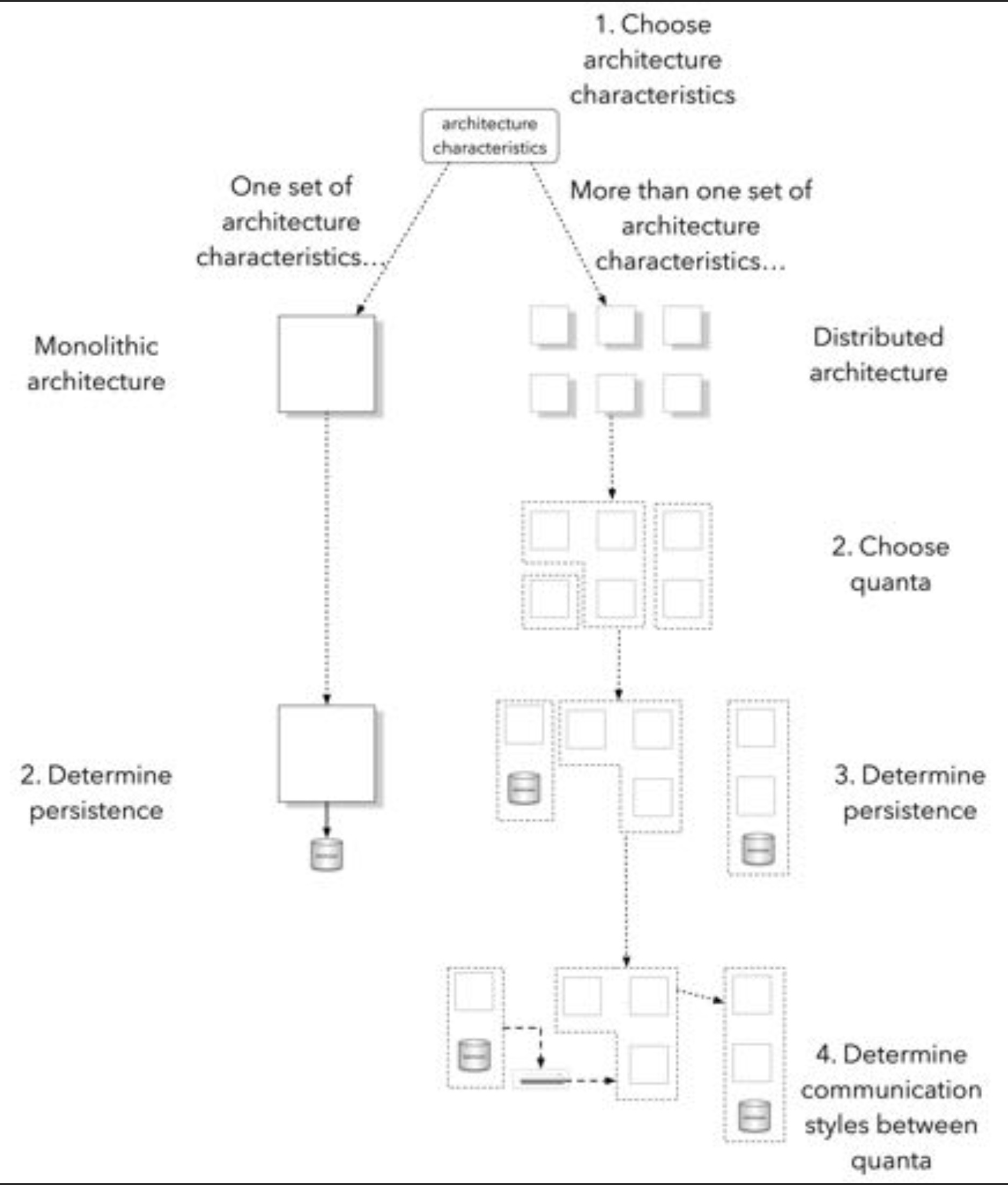
An architectural quantum is an independently deployable component with high functional cohesion and synchronous dynamic quantum connascence.
Choosing an Architecture
Service Granularity
Get granularity right by iteration!
Drivers
When should I consider breaking apart a service?
- Functionality or Domain
- Code Volatility
- Scalability and Throughput
- Fault Tolerance
- Data Security
Factors
What factors influence service granularity?
- Database Transactions
- Data Dependencies
- Communication Pattern i.e. Orchestration (Workflow) vs Choreography
Evolutionary Architecture
An evolutionary architecture supports guided, incremental change across multiple dimensions.
Fitness Functions
Any mechanism that provides an objective integrity assessment of some architectural characteristic(s).
Examples:
- Cyclic Dependency Function in Code Quality Tools
- Zero Day Security Check Function in Build Pipeline
- Contract Fitness Function using Consumer Driven Contracts
- Tool: Pact
Architecture Governance Tools:
- Java - ArchUnit
- .NET - NetArchTest, SonarQube
Coupling
Aim for High Semantic Coupling & Low Syntactic Coupling
Contract Types and Trade-offs
| Strict Contracts | Value Based Contracts |
|---|---|
| Method Signatures. Ex. SOAP, gRPC etc. | Name-Value Pairs. Ex. JSON |
| better control of exact parameter passing | requires fitness functions |
| brittle architecture coupling | requires documentation |
| better documentation via type signatures | extremely loose coupling |
Managing Data in a Distributed System
- Inter-Service Communication
- Data Replication
- In-Memory Replicated Cache
- Data Domains (Shared Tables)
Achieving Scalability and Elasticity
Patterns to leverage in Microservices:
- Cache
- Sidecar Containers with Service Mesh